Mark your calendars for an inspiring evening at the upcoming CTS Talks, a series of lectures given at Christian Theological Seminary in Indianapolis, featuring a thought-provoking presentation by our director, Dr. Hannah L. Maxey. As a guest speaker, Dr. Maxey will deliver a talk titled “Mental Health: The Crisis and a Call to Action for People of Faith.” This timely discussion will address the critical issue of mental health in America and its significant impact on individuals and communities of faith. Dr. Maxey will explore how faith communities are uniquely positioned to respond to this crisis, challenging attendees to become ambassadors of love and hope. Her expertise promises to shed light on the silent struggles many face due to stigma and the difficulties in accessing care amidst professional shortages.
CTS Talks is known for its TED Talk-style lectures that bring together intellectual curiosity and community reflection. By participating in this event, our director contributes to a broader conversation on mental health and faith.
I am most passionate about mental health in two ways. One is regarding the mental health of our children and everything they navigate through with technology and social media. As parents, we are watching our children grow up in a world that differs greatly from the world we grew up in as children. Children are being exposed to technology and devices at a young age, whether it be personally or through friends. Devices provide them with an entire online world, including social media. Our family experienced just how detrimental this can be to our children’s mental health.
Our personal story is one that I don’t share often but I will say, we are truly fortunate to have had a close-knit village of friends and family who helped us on our journey and without them, we wouldn’t have made it through. From a parent’s perspective, the biggest challenge we faced was trying to educate ourselves while also trying to afford therapists and additional resources. Therapy is costly, and many therapists do not accept insurance. Prior to joining the Bowen Center, my family struggled with mediocre health insurance, but without it, we would have gone broke trying to get our daughters the help they needed. Covering $125 weekly therapy sessions out of pocket was costly, but in our minds, absolutely necessary. We were willing to pay any amount to get our daughters the help they needed.
Second, is the story of my sister, Taylor Nielsen, a former police officer who began struggling with post-traumatic stress disorder in 2016, following a traumatic case. More information on her personal story is found in the 2018 article New Police Mental Health Awareness Law Celebrated. Taylor inspired the Law Enforcement Mental Health and Wellness Act. She was honored to attend President Trump’s January 30th, 2018 State of the Union address as Senator Donnelly’s guest.
While what she experienced was tragic, what transpired from that experience will be life-changing for so many. She has since left the department and moved to Arizona, where she is taking classes toward her Psychiatry license, focusing on working with first responders. In addition, our daughter is attending IU Bloomington this fall to major in Psychology. I am very proud of both of them for being strong enough to share their stories and for using their experiences to help others who are struggling!
Bowen Center Director Dr. Hannah Maxey presented August 1 the Playbook for Enhancing Indiana’s Mental and Behavioral Health Workforce to the Indiana Commission to Combat Substance Use Disorder. Indiana faces an enormous challenge of recruiting and retaining a sufficient number of mental and behavioral health workers, with every county in the state meeting the criteria for a federally designated workforce shortage in these areas.
The results are staggering, with real-life implications for hundreds of thousands of Hoosiers:
Top Health Workforce Themes in the 2024 Legislative Session
Let’s cut to the chase. What health workforce legislation has been introduced in the 2024 session? There were a few major themes that arose. We have conceptualized these themes and summarized the outcomes below.
Nursing Workforce
This session has seen many legislative initiatives related to the nursing workforce. One such bill (SB 45) would establishadditional training requirements in trauma-informed care for all licensed Registered Nurses (RN). One bill would modify certain licensure requirements for health facility administrators, allow NCLEX passage to satisfy English proficiency requirements for internationally-educated nurse applicants, and eliminate telehealth certification requirement for telehealth nurses and other telehealth providers (HB 132). The final nursing-focused bill making progress this session makes various changes to nurse licensing, education, and training regulations regarding requirements for clinical preceptors, and requirements for certain foreign nursing applicants (HB 1259).
Bills under this theme that were introduced but did not progress include: a bill removing the collaborative practice agreement with physicians and APRNS, and allows a APRN with prescriptive authority to prescribe a schedule II substance (HB 1059); a requirement for nurses to complete implicit bias training as part of their continuing education requirements (HB 1167); establishment of nurse staffing councils within hospitals in order to develop nurse staffing plans (HB 1015); allowing Certified Registered Nurse Anesthetists to administer anesthesia under the immediate presence of a podiatrist or dentist, which is currently only allowed under the presence of a physician (HB 1371).
EMS
There have been several bills introduced regarding Hoosier emergency medical services professionals (EMS) this session. HB 1142 would establish a program of recognition for first responders killed or injured in the line of duty. A new grant pilot program was introduced in SB 10 for the purpose of assisting in the costs of mobile integrated health care programs and mobile crisis teams across Indiana. Finally, SB 142 would require healthcare coverage for mobile integrated healthcare and emergency medical services for all state employees on the state employee health plan (and other insurers).
Bills under this theme that were introduced but did not progress include: HB 1118 would establish a program to support the mental health of first responders through the Indiana first responders mental health wellness fund and program.
Regulatory Changes
House Bill 1214 would add Indiana to the Dental and Dental Hygienist Licensure Compact.
Bills under this theme that were introduced but did not progress include: A bill proposing the expansion of eligible clinical experience supervision to include physicians, and psychologists for the Clinical Social Work Licensure and expansion of supervision through telehealth (SB 261); bills that would establish new licenses – Professional Music Therapists (HB 1103) and Naturopathic Physicians (SB 262); and a bill (SB 110) that would add Indiana as a member of the Social Work Compact.
Behavioral Health Workforce
A bill proposed in the House would allow a Social Worker licensee applicant to take the social worker examination during their last term of a program that meets educational requirements, and provides a letter of good standing from the director of the academic department (HB 1138). This bill would allow a student to sit for their professional exam early if all requirements in the bill are met. House Bill 1238 would add certain physician assistants and advanced practice nurses as potentially qualifying professionals to serve as competency evaluators in criminal proceedings (previously only psychiatrists and psychologists).
Bills under this theme that were introduced but did not progress include: SB 166 which would have allowed community mental health center staff to provide social work services without a license and remove examination requirement for BHHS temporary permits; SB 261 which would have expanded the qualifications for clinical experience supervisors for clinical social workers and expanded tele-supervision.
Other health workforce themes from legislators that didn’t make it to the second chamber:
Health Workforce Incentives
There were a few bills related to health workforce specific incentives, including a bill that would establish a medical school loan forgiveness pilot program (HB 1175). Another bill would establishanIndiana rural hospital and critical health care services fund, new health workforce student loan repayment program, and associated health workforce advisory board (advisory board (HB 1196).
There’s More on the B4!
One way we monitor health workforce trends is by tracking Indiana health workforce legislation through implementation of the Bowen Bi-Weekly Bill Brief or “B4.” There are many other health and workforce/education-related bills that have been introduced this session. Check out the full B4 to learn more about those bills and keep track of the active bills as they progress through the second half of session!
The Bowen Center believes in the power of data to support informed policy.
Workforce data provides valuable insights regarding trends in and dynamics of supply, pinpoints where shortages exist and informs emerging workforce models which aim to fill gaps. The Bowen Center supports Indiana’s efforts to collect data on licensed healthcare occupations. When health professionals renew their Indiana license, they provide supplemental information through a series of questions structured to capture data needed to inform state policy, such as: where they practice, how many hours they work, demographics, and their plans for the future. Our team partners with the state to transform these data into reports and briefs that (we hope) promote a better understanding of Indiana’s health workforce, the strengths, challenges, and where opportunities exist to fill gaps.
Recently, we were approached to provide data insights on the contraceptive care workforce – where Indiana had potential contraceptive care providers, and where there were gaps. These data were used to inform 2023 House Enrolled Act 1568. This bill expanded the role of trained pharmacists by allowing them to prescribe hormonal contraceptives to adult women, a service that was previously held by traditional prescribers – generally physicians, advanced practice registered nurses, and physician assistants. Lawmakers wanted to understand the potential impact on access to contraceptive care if pharmacists were granted the ability to contribute as prescribers.
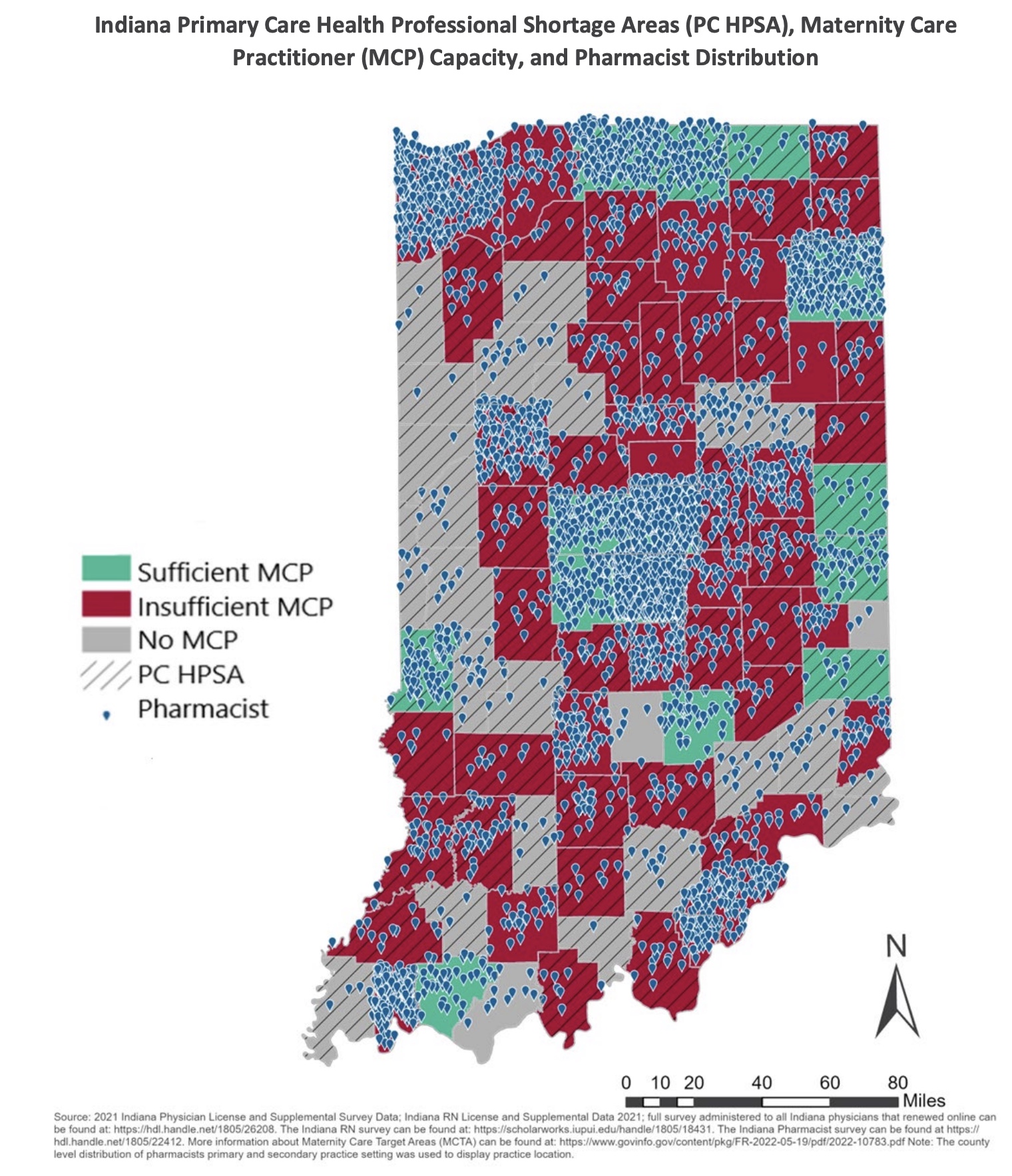
Leveraging workforce data, the Bowen Center generated a policy briefandmap that examined the distribution of primary care andmaternity care practitioners and pharmacists across Indiana. The map revealed that pharmacists were spread out more widely across the state than primary care and maternity care practitioners,with at least one pharmacist practicing in every one of Indiana’s 92 counties, including within counties that are underserved by traditional contraceptive prescribers. Supporters of the legislation used this map during debate in the statehouse, and backed by evidence, HB 1568 successfully passed through the legislature and was signed into law by the governor. More information about the methodology and findings from this research request can be found in our accompanying brief.
What makes Effective Data?
In fulfilling this data request, we realized this exercise might provide us an opportunity to share our thoughts on the “values” that a dataset might hold in order to be used most effectively to support informed policy.
1. Timeliness and Accuracy.
It is crucial to use the most up-to-date information to have a current understanding of labor market conditions. Outdated or inaccurate data can lead to decisions based on flawed information. The supplemental data used for the Bowen Center’s primary care, maternity care, and pharmacist map were collected within the last two to three years, ensuring its relevancy. Physician and APRN data came from the 2021 license renewal cycle, while pharmacist data was sourced from the 2020 report. To identify primary care shortage areas and maternity care capacity, a trusted federal source, the Health Resources & Services Administration, was utilized.
2. Relevance.
Workforce data analysis should align with the strategic goals and priorities of the inquiry and should provide actionable insights that can help improve stakeholder understanding without the addition of extraneous data points. This means that the data should be sufficient to provide an understanding of the workforce’s capacity and capabilities with the minimum amount of information needed to answer the research question. In the case of the policy relevant inquiry related to contraception prescribing, the quick turnaround map was created to gain a better understanding of the issue. The map included only relevant data, designed to be easily comprehensible “at a glance.” Each data element in the map contributed to answering the central question: Might access to contraceptives be impacted if pharmacists were permitted contraceptive prescribing privileges?
3. Comprehensiveness.
To maximize the utilization of data, it is ideal to have a complete picture of the workforce that addresses the initial query. It’s important to consider all the necessary information that contributes to an accurate understanding of workforce distribution. Indiana’s practice of collecting supplemental data during the licensure renewal process provides essential workforce information that would not be gleaned from the license renewal data alone. Without this additional data, Indiana would be unable to identify such elements as practice location, FTE and practitioner specialty, severely hampering a comprehensive understanding of the workforce in Indiana. From this valuable supplemental data, we were able to incorporate both primary care and maternity care capacity as separate mapped elements since both groups can prescribe hormonal contraceptives. By including all significant workforces, we assure that the take-away is a comprehensive depiction of the current state of relevant healthcare in Indiana.
4. Balance of Granularity and Aggregation
Data should strike a balance between being detailed enough to capture the nuances of the workforce landscape and providing an overview of the bigger picture. The policy map achieved this balance by using both granular and aggregate data in a user-friendly format. Indiana Primary Care Health Professional Shortage Areas and Maternity Care Practitioner capacity were aggregated across counties using two different visual tools, while pharmacist data was presented more granularly with individual pinpoints for each practice location. This allowed for a quick understanding of workforce capacity in specific areas without losing sight of the broader workforce gaps.
Research and data analysis are vital components of the policy and legislative process. Data analysis that is carefully considered and displayed in a user-friendly way can play an important supporting role in policymaking by providing actionable, evidence-based insights. The successful passage of House Enrolled Act 1568-2023 in Indiana demonstrates that data-driven approaches can help policymakers make informed decisions that can positively impact the health and well-being of people in the state. Ultimately, it contributes to the delivery of comprehensive, high-quality healthcare. At the Bowen Center, we are honored to be able to provide data that empowers Indiana policymakers.
We’ve re-thought and redesigned our data reports, and are moving to a web-based design, which allows for more interactivity and lets users directly download the underlying data. Let us know your thoughts on this new, web-first interactive data report design by sending an email to bowenctr@iu.edu.