Indiana Medical Education Pipeline to Practice Project Summary Published

Indiana Medical Education Pipeline to Practice Project Summary Published

Retention of medical students and residents is crucial to ensuring a strong physician workforce. This report examines retention within Indiana’s medical education pipeline between 2019 and 2024, challenges faced by residency program directors, trends in physician workforce capacity at Indiana hospitals, and existing initiatives supporting medical education and training in Indiana.

This work was completed in collaboration with the Indiana Department of Health. It is our hope that this report can inform discussions and policies targeting medical education in Indiana.

Read and download the project summary report below or find the full report here.

A Regulatory Review of APRN Oversight in Indiana

A Regulatory Review of APRN Oversight in Indiana

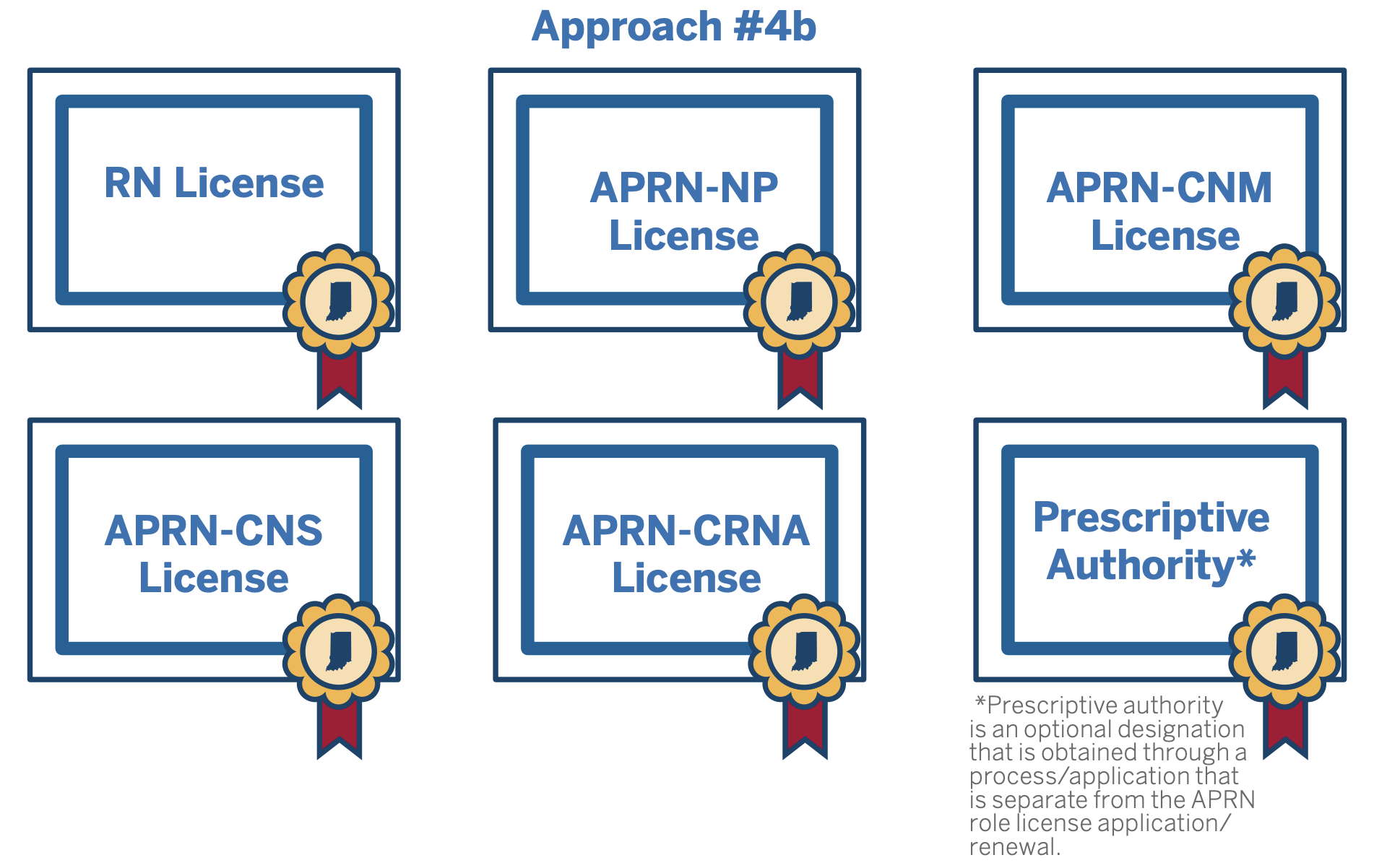
As of 2023, there were 9,134 Advanced Practice Registered Nurses (APRN) reported to be practicing in Indiana. These APRNs include Nurse Practitioners (NP), Clinical Nurse Specialists (CNS), Certified Nurse Midwives (CNM), and Certified Nurse Anesthetists (CRNA). APRNs are required to be licensed as Registered Nurses (RN) and meet certain educational criteria to provide APRN-level services. CNMs are the only APRNs required to hold a separate, dedicated license in Indiana. Many Indiana APRNs (NP, CNS, CNM only) hold a prescriptive authority license. This license enables APRNs to prescribe medications and requires collaborative practice agreements with a licensed physician, dentist, podiatrist, or optometrist. Approximately 71% of Indiana APRNs hold prescriptive authority licenses, meaning about 29% of RNs who self-identify as APRNs hold no APRN-level license. 

In 2023, the Bowen Center conducted a fifty-state policy review of APRN licensing regulations and published the findings in a corresponding report. This policy review revealed that only Indiana and Wisconsin do not require APRN-level licensure for all practicing APRNs. Currently, Indiana has no formal process of tracking the number of APRNs, unless they are Certified Nurse Midwives, or hold prescriptive authority. Collection of data on APRNs is reliant on RNs self-reporting as APRNs. This leads to several potential challenges including the inability for individuals to easily verify credentials of APRN providers and lack of consistent and sufficiently granular data for workforce planning.  

Based on the national policy review, the Bowen Center identified 4 prevailing implementation approaches to APRN licensure. SB447 and HB1151 aim to create separate licenses for each advanced nursing role, which aligns with Approach #4 outlined in the figure below.  
Regardless of the approach, it’s important that APRNs do not face a complicated licensure process. Key consideration include: 

  • Ensuring reciprocity and portability of licenses 
  • Reducing administrative burdens for license holders and state agencies 
  • Minimizing additional licensure costs  

Professional regulation ensures quality service and public safety. The question to consider: Would an Indiana APRN license be helpful to protect public health and safety and support modernization of regulation, or are the current regulatory strategies sufficient? 

Check out the full report here: Advanced Practice Registered Nurse Licensing.

How States Regulate Certified Nurse Aides

How States Regulate Certified Nurse Aides

Certified Nursing Aide Regulation

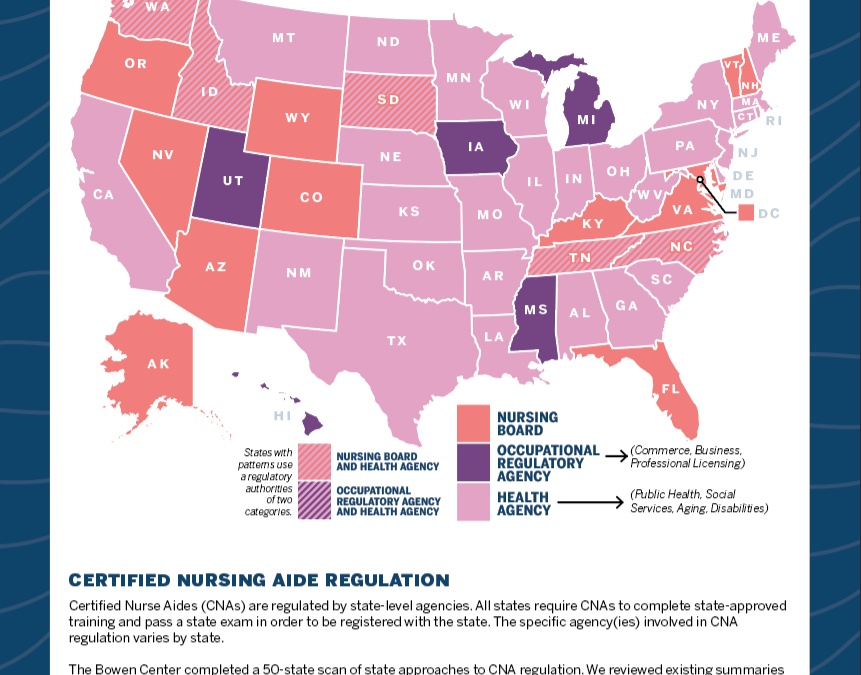
Certified Nurse Aides (CNAs) are regulated by state-level agencies. All states require CNAs to complete state-approved training and pass a state exam in order to be registered with the state. The specific agency(ies) involved in CNA regulation varies by state.

The Bowen Center completed a 50-state scan of state approaches to CNA regulation. We reviewed existing summaries from 2022 and 2024, and explored current statutes and administrative codes to categorize state approaches to regulation as being led by the nursing board, occupational regulatory agency, health agency, or a combination. The map below shows the results of the scan.


Read or download the above blog post in PDF form here:

Inside Indiana Business: IU unveils Playbook to address mental health workforce shortage

Inside Indiana Business: IU unveils Playbook to address mental health workforce shortage

Bowen’s Playbook to tackle the crisis in Indiana’s mental health is gaining traction and getting attention around Indiana. Read this latest in this article from Inside Indiana Business:

The Indiana University School of Medicine’s Bowen Center for Health Workforce Research and Policy has developed a playbook of recommendations to boost the number of mental health professionals in the state.

Read more on the Inside Indiana Business website here. 

Indiana’s mental health care is in crisis, with both real-life impacts on the everyday lives of millions of Hoosiers and for the long-term economic outlook of our state. Our Playbook tackles that crisis head-on, offering concrete policy solutions to increase the number of mental health care workers in Indiana. Find out more here.

Fort Wayne Journal-Gazette: New report details shortage of mental health professionals in Indiana

Fort Wayne Journal-Gazette: New report details shortage of mental health professionals in Indiana

Bowen’s Playbook for Enhancing Indiana’s Mental and Behavioral Health Workforce is getting attention in the press across Indiana. Check out this article from the Fort Wayne Journal-Gazette:

Indiana has a shortage of mental health professionals, a situation a provider describes as a crisis, a report released Wednesday says.

“The Playbook for Enhancing Indiana’s Mental and Behavioral Health Workforce” seeks to address that shortage by identifying opportunities and recommendations to strengthen the state’s pipeline of those professionals.

Read more on the Journal-Gazette website here. 

Indiana’s mental health care is in crisis, with both real-life impacts on the everyday lives of millions of Hoosiers and for the long-term economic outlook of our state. Our Playbook tackles that crisis head-on, offering concrete policy solutions to increase the number of mental health care workers in Indiana. Find out more here.