Rural Health in Indiana: Challenges and Strategies

Rural Health in Indiana: Challenges and Strategies

Bowen Assistant Director of Data and Research Sierra Vaughn

Bowen’s Assistant Director of Data and Research Sierra Vaughn gave a presentation on rural health care in Indiana to the Indiana Rural Health Association on August 1.

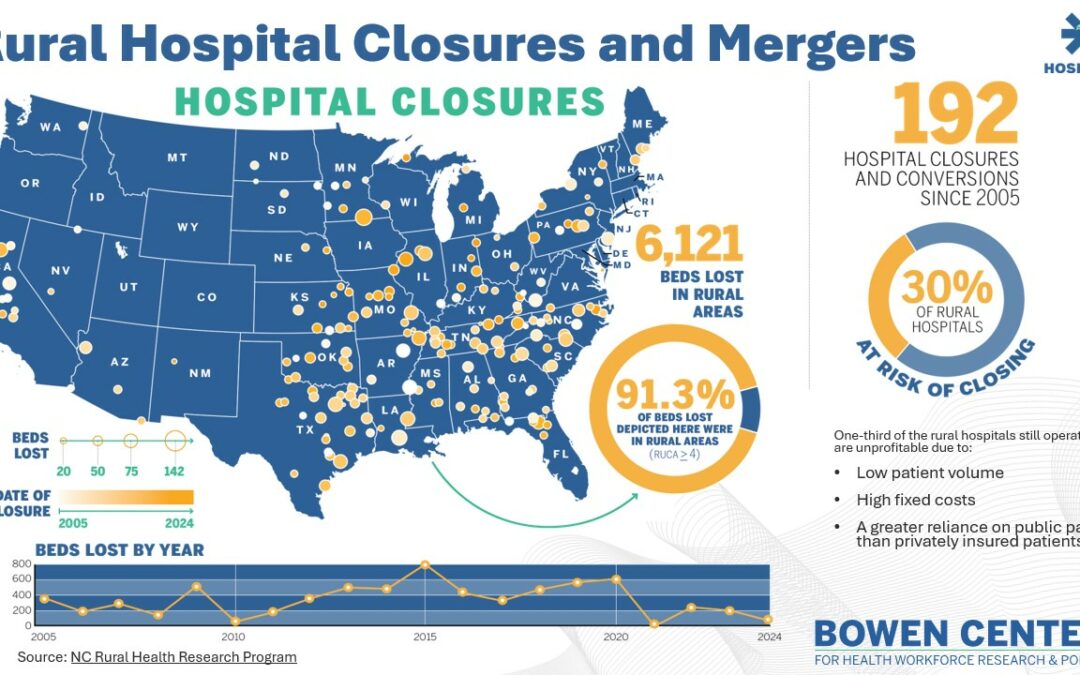
Mirroring national trends, rural health care in Indiana faces significant challenges. The state has seen hospital closures, with 52 rural hospitals remaining as of 2024, and 25% of open hospitals experiencing service reductions. Workforce shortages are acute, particularly in mental health, where rural areas have two-thirds fewer behavioral health professionals than urban areas. Additionally, 35 Indiana counties lack a birthing hospital, impacting maternal care access. These issues are compounded by broader rural health disparities, including slower life expectancy increases and higher mortality rates for conditions like heart disease and cancer compared to urban areas.

Read more about the challenges faced by rural hospitals in Indiana and nationwide as well as potential solutions in Vaughn’s presentation here:

Policymakers Tapping into the Power of Indiana’s Health Workforce Data

Policymakers Tapping into the Power of Indiana’s Health Workforce Data

The Bowen Center believes in the power of data to support informed policy. 

Workforce data provides valuable insights regarding trends in and dynamics of supply, pinpoints where shortages exist and informs emerging workforce models which aim to fill gaps. The Bowen Center supports Indiana’s efforts to collect data on licensed healthcare occupations.  When health professionals renew their Indiana license, they provide supplemental information through a series of questions structured to capture data needed to inform state policy, such as: where they practice, how many hours they work, demographics, and their plans for the future.  Our team partners with the state to transform these data into reports and briefs that (we hope) promote a better understanding of Indiana’s health workforce, the strengths, challenges, and where opportunities exist to fill gaps. 

Recently, we were approached to provide data insights on the contraceptive care workforce – where Indiana had potential contraceptive care providers, and where there were gaps. These data were used to inform 2023 House Enrolled Act 1568. This bill expanded the role of trained pharmacists by allowing them to prescribe hormonal contraceptives to adult women, a service that was previously held by traditional prescribersgenerally physicians, advanced practice registered nurses, and physician assistants. Lawmakers wanted to understand the potential impact on access to contraceptive care if pharmacists were granted the ability to contribute as prescribers.

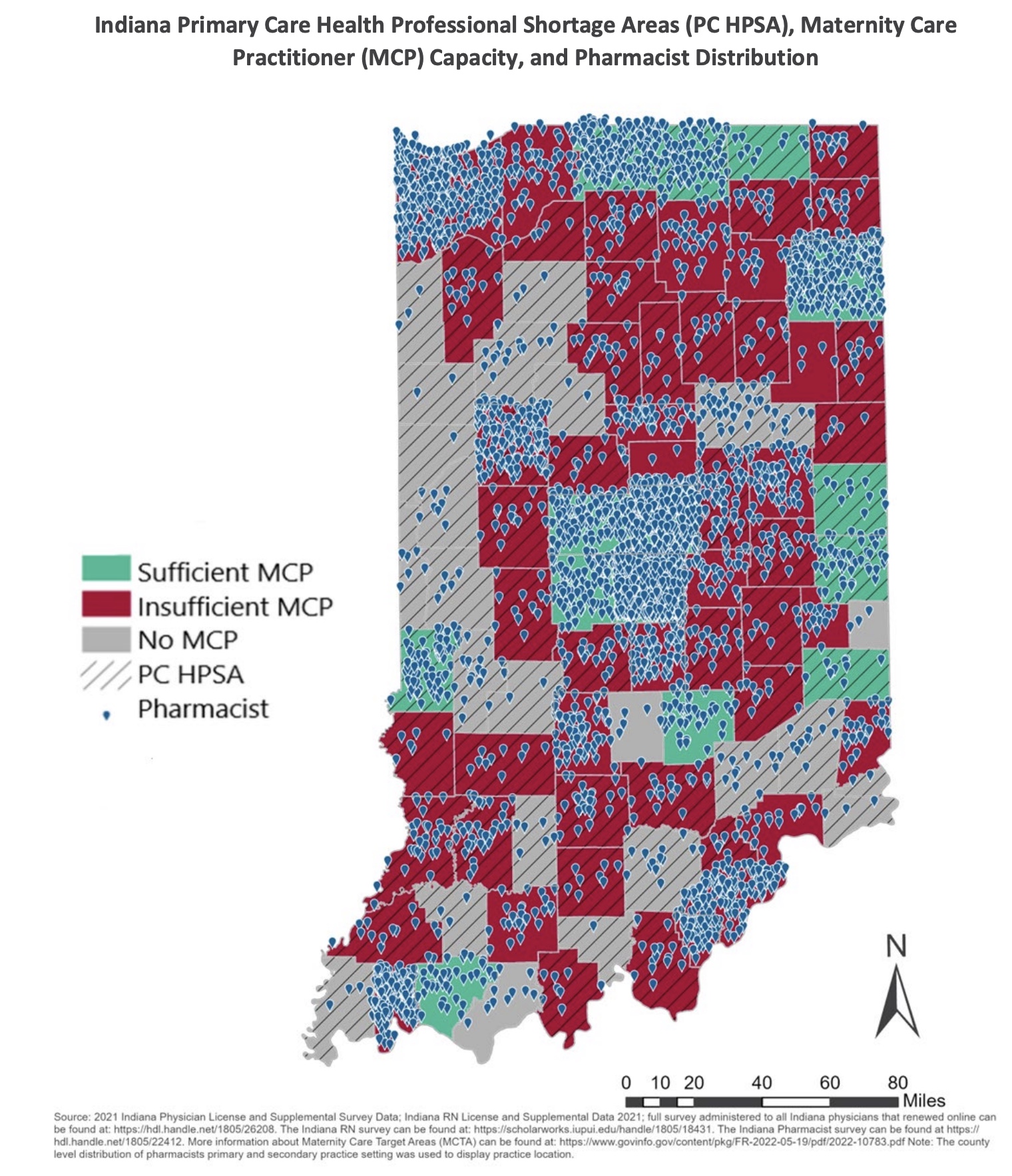
Leveraging workforce data, the Bowen Center generated a policy brief and map that examined the distribution of primary care and maternity care practitioners and pharmacists across Indiana. The map revealed that pharmacists were spread out more widely across the state than primary care and maternity care practitioners, with at least one pharmacist practicing in every one of Indiana’s 92 counties, including within counties that are underserved by traditional contraceptive prescribers. Supporters of the legislation used this map during debate in the statehouse, and backed by evidence, HB 1568 successfully passed through the legislature and was signed into law by the governor. More information about the methodology and findings from this research request can be found in our accompanying brief. 

What makes Effective Data?

In fulfilling this data request, we realized this exercise might provide us an opportunity to share our thoughts on the “values” that a dataset might hold in order to be used most effectively to support informed policy. 

1. Timeliness and Accuracy.

It is crucial to use the most up-to-date information to have a current understanding of labor market conditions. Outdated or inaccurate data can lead to decisions based on flawed information.

The supplemental data used for the Bowen Center’s primary care, maternity care, and pharmacist map were collected within the last two to three years, ensuring its relevancy. Physician and APRN data came from the 2021 license renewal cycle, while pharmacist data was sourced from the 2020 report. To identify primary care shortage areas and maternity care capacity, a trusted federal source, the Health Resources & Services Administration, was utilized.

2. Relevance.

Workforce data analysis should align with the strategic goals and priorities of the inquiry and should provide actionable insights that can help improve stakeholder understanding without the addition of extraneous data points. This means that the data should be sufficient to provide an understanding of the workforce’s capacity and capabilities with the minimum amount of information needed to answer the research question.

In the case of the policy relevant inquiry related to contraception prescribing, the quick turnaround map was created to gain a better understanding of the issue. The map included only relevant data, designed to be easily comprehensible “at a glance.” Each data element in the map contributed to answering the central question: Might access to contraceptives be impacted if pharmacists were permitted contraceptive prescribing privileges?

3. Comprehensiveness.

To maximize the utilization of data, it is ideal to have a complete picture of the workforce that addresses the initial query. It’s important to consider all the necessary information that contributes to an accurate understanding of workforce distribution.

Indiana’s practice of collecting supplemental data during the licensure renewal process provides essential workforce information that would not be gleaned from the license renewal data alone. Without this additional data, Indiana would be unable to identify such elements as practice location, FTE and practitioner specialty, severely hampering a comprehensive understanding of the workforce in Indiana. From this valuable supplemental data, we were able to incorporate both primary care and maternity care capacity as separate mapped elements since both groups can prescribe hormonal contraceptives. By including all significant workforces, we assure that the take-away is a comprehensive depiction of the current state of relevant healthcare in Indiana.

 4. Balance of Granularity and Aggregation

Data should strike a balance between being detailed enough to capture the nuances of the workforce landscape and providing an overview of the bigger picture.

The policy map achieved this balance by using both granular and aggregate data in a user-friendly format. Indiana Primary Care Health Professional Shortage Areas and Maternity Care Practitioner capacity were aggregated across counties using two different visual tools, while pharmacist data was presented more granularly with individual pinpoints for each practice location. This allowed for a quick understanding of workforce capacity in specific areas without losing sight of the broader workforce gaps. 


Research and data analysis are vital components of the policy and legislative process. Data analysis that is carefully considered and displayed in a user-friendly way can play an important supporting role in policymaking by providing actionable, evidence-based insights.  The successful passage of House Enrolled Act 1568-2023 in Indiana demonstrates that data-driven approaches can help policymakers make informed decisions that can positively impact the health and well-being of people in the state. Ultimately, it contributes to the delivery of comprehensive, high-quality healthcare. At the Bowen Center, we are honored to be able to provide data that empowers Indiana policymakers.

Through My Eyes: Work Experience in Diversity

Through My Eyes: Work Experience in Diversity

Often, I have heard that you learn more by way of experience than from school. I found this to be true as during the past year and a half that I have worked with the Bowen Center. I have learned valuable information that has made me a well-rounded public health professional and have gained an abundance of skills. The Bowen Center has taught me about the importance of access to care, diversity in our health workforce, and expanding care through policy implications such as health workforce training programs, loan repayment programs, and other means to retaining our health workforce.

Diversity in the health workforce is important for creating a thriving and successful work environment and work culture for all health professions. Moreover, diversity in the health workforce is crucial for both better access to care and higher quality of care for underserved communities (Walker, et al, 2012).[1] Recruitment of a diverse staff can lead to the removal of barriers to health-care access in these underserved communities. A workforce that is diverse in race, ethnicity, sex, and age can lead to delivering the best possible care to diverse patient populations (Stanford, 2020).[2] Higher quality of care in these areas then leads to increased patient satisfaction, which can also improve the overall health outcomes of Indiana (Gomez, 2019) (Harker, 2020)[3], [4]. Considering this impact, it is no wonder that recruiting and retaining a diverse health workforce has become a top priority at the state and federal levels.  

I participated in an examination of diversity in Indiana’s health workforce, and the first examination used historical data specific to Indiana physicians gathered during license renewal. This data shows much growth in diversity among physicians over the last 25 years. In 1997, less than 20% of physicians identified as non-white. In 2021, nearly one-third of fell into this group. Likewise, gender diversity has also increased, with women making up 18% in Indiana physicians 1997 and 32% in 2021.

More than looking at the numbers, I also examined the multitude of programs and initiatives which address workforce diversity and aim to support early recruitment of health professionals from underrepresented communities. Elements of these programs and initiatives may include incentive programs, such as scholarships and loan repayment options. It is essential to understand how important programs like these are and their roles in increasing the amount of diversity in the health workforce in Indiana.


Chelsea Sparks

Graduate Research Assistant

I utilized this experience in my graduate work by creating a pilot program for one of my master’s degree courses with guidance from the Bowen Center. This program was named “Better Together in the Physician Workforce” and aimed to promote culturally inclusive, and diversity driven workplace environments, starting with 3 program implementation locations. This program promotes change in diversity at these three locations through increased educational opportunities on the importance of workplace diversity, increased culturally sensitive materials, and opportunities for scholarship. The intended outcome of this program is that physicians working in these implementation locations will feel a better sense of belonging in their work environment, workplace culture will harbor diversity and inclusion overall, and physicians could further their education from funding opportunities such as scholarships or grants. It is important to me that I have contributed in some way to achieving health equity and the better representation of underrepresented minority group members and I feel as though I have done just that by building this program. This program has not been implemented; however, it is important to me that the entire program structure be built in hopes of one day launching a similar program and increasing diversity rates among the health workforce.

From this position, I now have several useful skills and even publications that I possess and can take with me to my future career. I currently have been working on a diversity report series that encompasses 11 different health professions for about a year now. This report series provides longitudinal trends in health workforce diversity in hopes of informing existing programs which aim to diversify the health workforce. I understand that I have contributed not only to public health, but also population health. Throughout this working experience I have been able to learn about higher level concepts regarding healthcare and how these concepts are tied to specific policies and impact public health overall. Not only did this graduate employment opportunity allow me to build public health skills, but it also gave me a deeper understanding of how the health workforce and other issues impact health equity. I now understand what racial concordance means and how healthcare workers reflect the populations that they serve

My colleagues at the Bowen Center have not only been the best mentors but have also given some of the best guidance and life advice to help me on my way. The Bowen Center also provides a space where I have maintained close relationships with my mentors and other coworkers. I understand that the next individual welcomed to the team as a graduate research assistant will gain a large amount of knowledge and plentiful experiences. I am thankful for this opportunity and am excited for the future.

If you would have asked me if I would have thought that at the start of my college career I would be in school for 7 years, I would have laughed.  So, as for me, I am not sure what my future holds, but I am sure that I am prepared for my next adventure as this team has helped me prepare a foundation for the career that I will pursue.

References

[1] Walker, K. O., Moreno, G., & Grumbach, K. (2012). The Association Among Specialty, Race, Ethnicity, and Practice Location Among California Physicians in Diverse Specialties. Journal of the National Medical Association104(1-2), 46–52. https://doi.org/10.1016/s0027-9684(15)30126-7

[2] Stanford FC. The Importance of Diversity and Inclusion in the Healthcare Workforce. J Natl Med Assoc. 2020 Jun;112(3):247-249. doi: 10.1016/j.jnma.2020.03.014. Epub 2020 Apr 23. PMID: 32336480; PMCID: PMC7387183.

[3] Harker, L. (2020, January 15). Unlocking the Benefits of an Inclusive Health Workforce. Georgia Budget and Policy Institute. Retrieved November 14, 2022, from https://gbpi.org/unlocking-benefits-diverse-health-workforce/

[4] Gomez LE, Bernet P. Diversity Improves Performance and Outcomes. J Natl Med Assoc. 2019 Aug;111(4):383-392. doi: 10.1016/j.jnma.2019.01.006. Epub 2019 Feb 11. PMID: 30765101.

Through My Eyes: Black Maternal Health

Through My Eyes: Black Maternal Health

Black maternal health has been a professional passion of mine since completing an internship focused on data informed policy solutions to Black maternal health issues while in graduate school. As a Black woman, it has also been a personal passion. When I became a mother in August of 2022, this issue only became dearer to my heart. I wanted to keep myself safe during pregnancy, labor, and postpartum and I want to find solutions that will keep my daughter safe once it’s time for her to become a mother.  

Black Maternal Health Week was first implemented by President Biden in 2021 (1). This week is focused on bring awareness to the pregnancy-associated health issues experienced by Black women in the United States. Maternal mortality, or pregnancy-related deaths, refer to any death during pregnancy or within the first year after birth that is caused by or exacerbated by pregnancy (2). National trends in the U.S. show that Black women have a maternal mortality rate 2.9 times higher than the maternal mortality rates for white or Hispanic women and, alarmingly, rates have increased since 2019 (3). In 2020, Indiana had the third highest maternal mortality rate in the entire country. Black Hoosier women had maternal mortality rates almost twice as high as white Hoosier women and almost three times as high as Hispanic Hoosier women (2). As a response, the Indiana state legislature passed SB 142 in 2018 (4) which established the maternal mortality review committee (MMRC). This committee is responsible for investigating the deaths of pregnant women or women up to 1 year postpartum, which are required to be reported by all health care providers in Indiana. Indiana cares about Black Maternal Health and has implemented state policies to improve it. The theme for Black Maternal Health Week this year is “Our Bodies Belong to Us: Restoring Black Autonomy and Joy”, and it is true – Black mothers can take control of their birthing experience.  

Lessons Learned

I’ve learned some things through my journey to motherhood that I’d like to share.  

1. Know Your Options. There are many different maternity care providers in Indiana, from traditional OB-GYNs to Advanced Practice Registered Nurses or Certified Nurse Midwives. Along with different providers, there are a variety of settings within which maternity care can be provided such as hospitals, birth centers and even within your own home. Don’t be afraid to shop around to find a provider that aligns with your values and your desires for your birth.  

The Bowen Center has published a detailed Maternity Care Workforce Assessment, which can be found here, and an accompanying brief, here. This resource details characteristics of all physicians or Advanced Practice Registered Nurses who report providing maternity care services. I personally chose to deliver in a hospital setting with a Certified Nurse Midwife. I also chose to have a doula as research seems to indicate the presence of a doula can reduce risk of maternal mortality and adverse birth outcomes (5,6) 

2. Be persistent. Diversity in medical providers can reduce risk of maternal mortality which led me to personally prioritize finding a provider that was from a racial minority group that is underrepresented in medicine (2,7). The Bowen Center has recently published a series of reports and briefs detailing diversity in a variety of healthcare professions. You can currently find the methodology here and the report on physicians here. Reports for registered nurses, pharmacists, dentists and other healthcare professionals are forthcoming.  

 In my own experience, I found it difficult to find a provider who accepted my insurance, was from a minority group and could see me without a long wait. I even switched my provider when I was 8 months pregnant because I felt I wasn’t in alignment with my first one. Be persistent, and don’t be afraid of uncomfortable conversations.  The payoff of having a maternity care provider who aligns with your values is worth the effort required for your best experience during pregnancy and childbirth.  

3. Prepare for postpartum. I spent a lot of time preparing for birth and preparing for bringing my sweet baby home, but not a lot of time preparing for my postpartum experience. The postpartum experience can be very difficult as you physically heal from giving birth, deal with sleeping less than before, adjust to your new role as a mother AND learn to care for a baby! It’s imperative that mothers have access to resources to deal with these changes. In 2022, Indiana passed HB 1140 which extended pregnancy Medicaid coverage to 1 year past birth to help ensure access to healthcare services during this sensitive time (8). Each legislative session, the Bowen Center posts bi-weekly updates on the progress of bills, like HB 1140, that are related to health or the health workforce. Whether it’s a health care provider to check on you physically or mentally, or a postpartum doula to help with laundry and the dishes, don’t be afraid to ask for help. There are options available for you.  

Becoming a mother has been the most joyful and fulfilling experience of my life and getting to watch my beautiful baby girl learn and grow is the best part of my life. Every mother deserves to experience that. I am very thankful to work on projects that highlight opportunities to enhance health workforce diversity. In fact, I am honored to have the opportunity to speak on this topic at my first national conference in Washington D. C. in May. I hope that the health workforce research I am involved in will improve Black maternal health enough that my daughter will not face the challenges that I faced when searching for a Black maternity care provider who shared my same vision for my birth.  

Be well.  

-Mykayla Tobin

Sources:

1. A Proclamation on Black Maternal Health Week 2021. Available at https://www.whitehouse.gov/briefing-room/presidential-actions/2021/04/13/a-proclamation-on-Black-maternal-health-week-2021/

2. Maternal Mortality in Indiana. Available at https://policyinstitute.iu.edu/doc/maternal-mortality-brief.pdf

3. Maternal Mortality Rates in the United States, 2020. Available at https://www.cdc.gov/nchs/data/hestat/maternal-mortality/2020/maternal-mortality-rates-2020.htm

4. Senate Bill 142. Available at https://iga.in.gov/legislative/2018/bills/senate/142

5. Advancing Birth Justice. Available at https://everymothercounts.org/wp-content/uploads/2019/03/Advancing-Birth-Justice-CBD-Models-as-Std-of-Care-3-25-19.pdf

6. Doula care across the maternity care continuum and impact on maternal health. Available at https://www.thelancet.com/journals/eclinm/article/PIIS2589-5370(22)00261-9/fulltext

7. Nurse workforce diversity and reduced risk of severe adverse maternal outcomes. Available at https://www.ajogmfm.org/article/S2589-9333(22)00121-5/fulltext#relatedArticles

8. House Bill 1140. Available at https://iga.in.gov/legislative/2022/bills/house/1140

Data Dump on Indiana’s Nurses in 2023

Data Dump on Indiana’s Nurses in 2023

In the last month the Bowen Center has published our two bi-annual data and brief reports from license renewals, but also two separate briefs. These two extra briefs look at how the Demand for RNs is expected to grow (our RN Demand Brief) and Licensing of APRNs, how Indiana does it versus how other states in the United States regulate these professionals (APRN licensure brief).

So to keep you in the loop on all things nursing, we’re going to do a quick overview of each of our nursing workforce materials that are hot off the press.

2021 Indiana’s Registered Nurse Workforce Brief

Take a dive into Indiana’s RN workforce. Explore trends, demographics, education, employment plans, practice characteristics, and policy connections. New sections look deeper into hospital-based, school-based, public health, and LTSS-based RNs.

2021 Indiana Registered Nurse Workforce Brief

2021 Indiana’s Registered Nurse Workforce Data Report

2021 Indiana’s Advance Practice Workforce Brief

Explore trends in Indiana’s APRN workforce. This brief also covers demographics, education, employment plans, practice characteristics, and policy connections.

2021 Indiana Advanced Practice Registered Nurse Workforce Brief

Advanced Practice Registered Nurse Licensing: Indiana’s Current Environment & Other State Approaches

Current Indiana law requires that all APRNs be licensed as Registered Nurses (RNs) and meet certain educational criteria to provide APRN-level services in their respective APRN role. An estimated one-fourth (28.8%) of RNs self-identified as APRNs but do not hold any additional licenses or authorities, and are providing advanced nursing care under their RN license. The absence of an advanced license for all APRNs in Indiana, regardless of prescriptive authority, poses some challenges for policymakers and the public.

Indiana’s approach to occupational regulation for APRNs is relatively unique. A 50-state review of APRN regulation determined that only one other state has a similar approach. The brief presents four (4) other approaches to APRN licensure and identifies considerations for each approach in terms of intersection with prescriptive authority, consumer perspectives, impact on practicing professionals, and administrative feasibility.

Advanced Practice Registered Nurse Licensing: Indiana’s Current Environment & Other State Approaches

RN Demand Brief

Over the next ten years, workforce projections estimate that demand for RNs jobs will increase by 30%. This brief examines the specifics of this predictions and breaks down that demand at a county-level. We hope this resource will give policymakers and stakeholders information to support planning for Indiana’s future nursing workforce

Indiana Registered Nurse Workforce Demand Brief

Nursing-related Bills in 2023

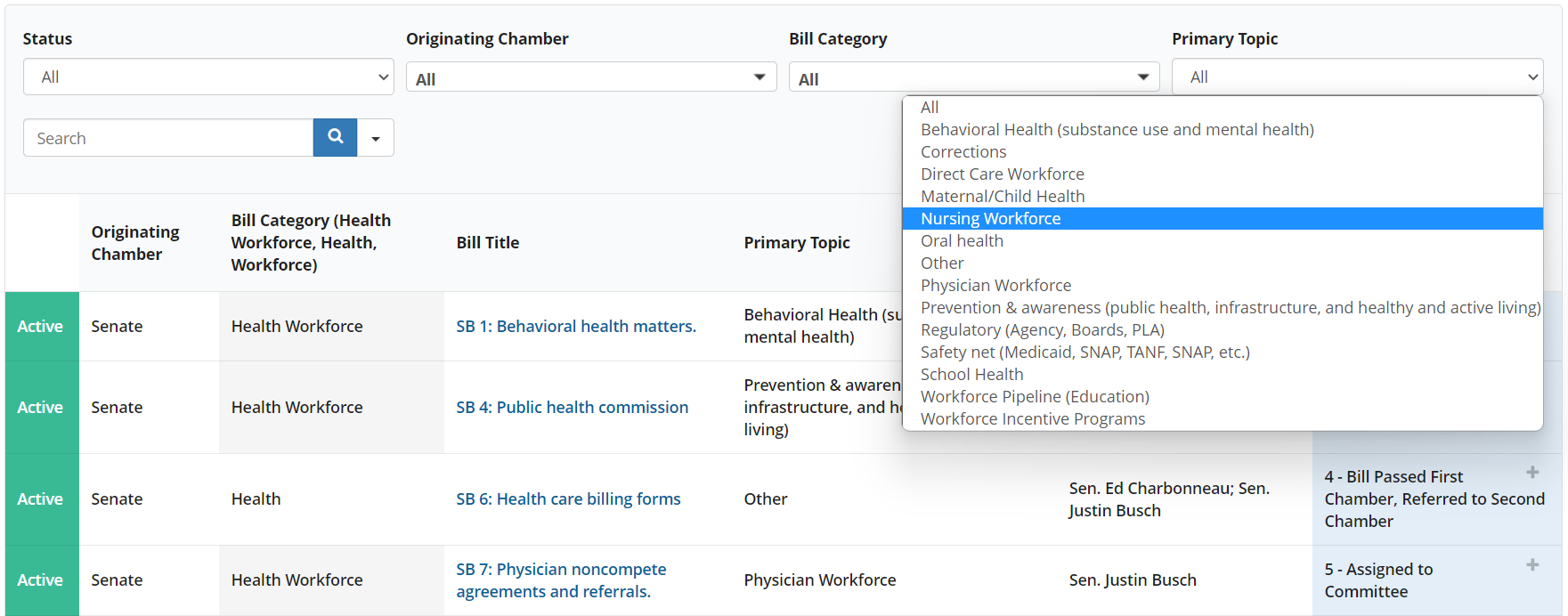
View our Bi-weekly Bill Brief to track Nursing Legislation.

Under the Primary topic tab, select “nursing workforce” or use the search bar to find related legislation.

Track these bills and more in our bi-weekly bill brief

License Renewal Survey FAQs

Why is it needed?

Over the last several decades, information has been collected from health professionals during their online license renewal. In 2018, Senate Enrolled Act 223 identified this information (including educational and practice characteristics) as being critical to the State of Indiana for health workforce planning. Beginning in January 2019, health professionals are now required to provide this information.

Questions asked at the beginning of the online license initiating and renewal process provides information which is collected and maintained in the Indiana Health Professions Database by the Bowen Center for Health Workforce Research & Policy. This information will provide the State of Indiana with an accurate representation of the health workforce and will be used to inform: workforce shortage areas, recruitment incentives, policy and programming, profession-specific initiatives and health workforce evaluations.

Need a printable version of this document? Click here.


Survey Related

  1. I have answered every survey question and hit the submit button, why can’t I proceed?
    The system will not proceed unless each question has a response. Please review each individual question to verify that a response has been selected> Even if the question is not applicable to you, please select “not applicable”.
  1. I am retired. Some of these questions don’t apply to me.
    Please scroll down to the bottom of the survey options and select Not Applicable. For questions with a text box, type in NA.
  1. What if I practice in more than one location?
    The survey will allow you the opportunity to provide information on multiple practice locations.
  1. What if I do not know the percentage of Indiana Medicaid patients at my primary practice location?
    This question is used to inform health professional shortage area designations. Please estimate to the best of your ability or select “Not Applicable” if you are not actively practicing.
  1. What if I do not know if my primary practice location is accepting new Indiana Medicaid patients?
    Your practice administrators and staff may have the answer to this question.  Please ask to see if this information is available through them.
  1. What if I do not know the percentage of patients on a sliding fee scale at my primary practice location?
    Your practice administrators and staff may have the answer to this question.  Please ask to see if this information is available through them.
  1. I recently received additional health professional credentials, yet I am not currently practicing in that role. How do I respond when asked to indicate my health professional role along and specialty?
    Please provide information that responds to your current role.


Technical Issues

  1. Which is the recommended internet browser to use while completing my online license renewal?
    The Indiana Professional Licensing Agency recommends using Internet Explorer.
  1. Why am I being kicked out of the system?
    This may occur due to the high volume of simultaneous online users or a browser issue. The Indiana Professional Licensing Agency recommends using Internet Explorer. If you are currently using a browser other than Internet Explorer, proceed with the following steps:
  1. Close out of your current browser
  2. Open Internet Explorer in a new tab
  3. Sign into the IPLA license renewal system
  4. Proceed with the license renewal process
  5. If you are currently using Internet Explorer and continue to experience technical issues, please try again at another time. 
  1. Why are my survey responses being erased?
    This may occur due to the high volume of simultaneous online users or a browser issue. The Indiana Professional Licensing Agency recommends using Internet Explorer. If you are currently using a browser other than Internet Explorer, proceed with the following steps:
  1. Close out of your current browser
  2. Open Internet Explorer in a new tab
  3. Sign into the IPLA license renewal system
  4. Proceed with the license renewal process
  5. If you are currently using Internet Explorer and continue to experience technical issues, please try again at another time.


General

  1. Is there a paper license renewal form that I can complete and mail in?
    Yes. For each licensed health profession, there is an option of completing a paper license renewal document. The link to the renewal document is listed on each health professions board’s webpage. It is also linked below for easy access:


Print and mail the completed document, along with the required renewal fee, to the Indiana Professional Licensing Agency. The mailing address is found on the license renewal document.


Still Have Questions?

If you have additional questions, please contact the Bowen Center for Health Workforce Research & Policy at bowenctr@iu.ed or 317-278-0316


Need a printable version of this document? Click here.