

Bowen Bill Brief: Connecting Workforce Data to Proposed Policy Solutions
The Bowen Center for Health Workforce Research and Policy is committed to informing health workforce policy that advances health. One way we do this is by staying up to date during the legislative session. Let’s discuss how the Bowen Center’s research and resources can support the work of the Indiana General Assembly.
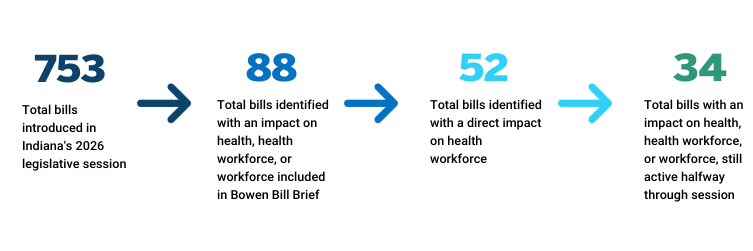
While there were no committee meetings held the week of January 26, deadlines for second and third readings occurred, meaning the number of bills the Bowen Center is tracking has decreased. From the original 88 bills, 34 are still moving through the legislative process, with several impacting workforces the Bowen Center actively monitors and reports on.
Nursing represents one of the largest health professions in Indiana, with over 73,500 registered nurses reporting that they actively provide clinical services to Hoosiers. The most recent series of workforce snapshots dives deep into this workforce. There are snapshots calling out data for all RNs, RNs only, advanced practice registered nurses, and the APRN subspecialties, including clinical nurse specialists, certified nurse midwives, and more. Many (78.7%) of these RNs completed their education in Indiana, making Indiana’s nursing program standards particularly important for nursing workforce development. House Bill (HB) 1278 would modify education standards for specified nursing programs, allowing programs in operation for at least five years to increase their enrollment at any rate they deem appropriate. Current law limits increases to not more than 100%.
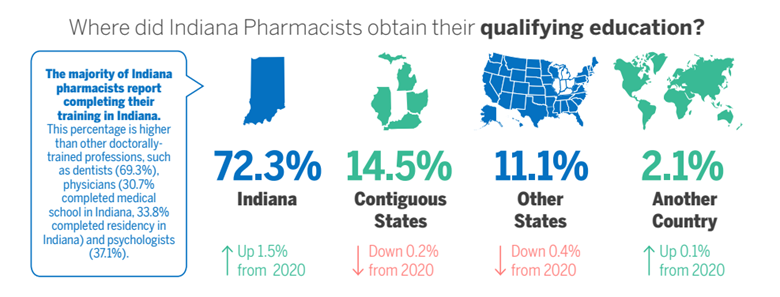
The Bowen Center also closely monitors Indiana’s pharmacy workforce. We publish reports on this workforce biannually, with the next report with fresh data coming early spring. Looking at the most recent report, published in 2024, 6,029 pharmacists reported actively practicing across the state, with 72.3% (n=4,359) of those individuals completing their education in Indiana. About 25.6% of all actively practicing pharmacists completed their education in the United States but not in Indiana.
Senate Bill (SB) 293 seeks to modify the requirements for licensure for those individuals who completed an educational program outside of Indiana. If passed into state law, this would require these individuals to complete an “initial course of education” covering federal and Indiana statutes and rules governing the practice of pharmacy.
When we look at issues that cut across the different occupations in the health workforce, the aging population is a major one. Nurses, pharmacists, physicians, behavioral health professionals, home health aides, and even unlicensed healthcare workers interact with the aging population, which continues to grow. The Bowen Center’s director, Dr. Hannah Maxey, testified to the U.S. Senate Special Committee on Aging in 2023, discussing the role states play in ensuring a qualified workforce ready to support the aging population (starting at 43:22). When we look at the data, we see 68% of nurses, 90% of pharmacists, 78% of physicians, and 88% of certified nurse aides report providing services to patients over the age of 65.
The Indiana General Assembly recognizing the importance of developing strong communities to care for and support aging adults, as there are several bills continuing to move through the process related to this demographic. This includes HB 1029, which would require the Indiana Department of Health to educate healthcare workers on the appropriate diagnosis, treatment, and care for Alzheimer’s disease and dementia. SB 222 also has provisions related to Alzheimer’s disease, dementia, and the healthcare workforce. The bill would rename the Bureau of Aging and In-Home Services and require the new Bureau of Better Aging to develop a dementia strategic plan for enhancing the dementia-based health workforce, including describing dementia-specific training requirements and how to increase the number of individuals interested in dementia care and geriatrics careers in the future.
As always, the Bowen Center will be back next week to infuse our research and resources into health workforce policy conversations.