
The 2026 Bowen Bill Brief (B3) is now live! This year marks the 8th year the Bowen Center has monitored health workforce legislation introduced in the Indiana General Assembly.
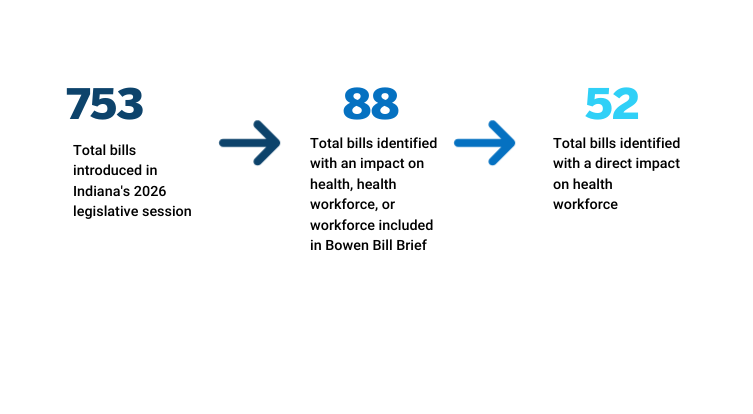
This year, 753 bills were introduced, and the Bowen Center will be tracking 88 that relate to or significantly impact the health workforce. Of those, 52 have direct relevance to the health workforce and are indicated as such in the B3.
The bills the Bowen Center is tracking cover diverse topics, with Other, Cost, and Regulatory being the most common categories. Bills in these categories cover issues like battery against health care providers (House Bill (HB) 1040), health care debt and insurance reimbursement (HB 1393, Senate Bill (SB) 178), and modifications to regulatory boards (HB 1230). This year, we’ll focus on areas where the Bowen Center can elevate research and data into policy discussions.
The Bowen Center recently released a brief outlining Indiana’s capacity for clinical training within the behavioral health and human services (BHHS) workforce. In it, we described findings that BHHS professionals (social workers, counselors, and therapists) report challenges serving as clinical or field preceptors because of the impact on their pay, productivity, and workflow. This information builds on the findings of the Playbook Project, which involved stakeholder engagement with behavioral health professionals, employers, and educators across Indiana.
During that project, stakeholders raised concerns about the length of time it takes to enter the behavioral health workforce. Following the typical path, students may spend 4 years earning a bachelor’s degree, another 2 years earning a master’s degree, and another 2 years of practicing under supervision before reaching independent practice.
Legislators are cognizant of these challenges, and there are several behavioral health bills this session. SB 68 seeks to directly address these delays and would require higher education institutions to create at least one accelerated graduate degree program to reduce the time needed to enter the workforce. SB 222 focuses on the peer support workforce and would define certified peers as individuals trained and certified by the Department of Mental Health and Addiction or an approved national body. HB 1134 seeks to expand the definition of treatment for mental illness or substance use to include services provided by behavioral health professionals holding associate licenses or the licensed social work license.
The General Assembly has been hard at work! Both the Senate Health and Provider Services Committee and the House Public Health Committee met during the week of January 12. Several bills with direct relevance to the health workforce were discussed during their meetings, including SB 222 described above. As examples, SB 173 and HB 1254 were passed with amendments out of their respective committees. These bills seek to open a pathway to licensure as dental hygienists for individuals with dental doctorates from foreign countries, in addition to other policies affecting the health workforce.
What does the data tell us about dental hygienists? More than 3,800 dental hygienists are providing services to Hoosiers in all but 3 of Indiana’s 92 counties. Looking at demand, estimated job growth in Indiana outpaces national job growth. If passed, this legislation may increase the number of dental hygienists practicing in the state, supporting the oral health needs of Hoosiers. For more information, check out the Bowen Center’s new brief: Indiana’s Dental Hygiene Workforce 2024 Supply and Demand.
Looking at emergency medical services (EMS), the Bowen Center has partnered with the Indiana Department of Homeland Security since 2023 to monitor and report on the EMS workforce. This partnership has resulted in a statewide assessment of the workforce, student reports summarizing the perceptions of individuals pursuing these careers, and informational flyers to support recruitment and retention. State legislators are considering various bills related to this workforce, including HB 1251, which would define EMS as essential in Indiana, requiring county commissioners to identify areas with insufficient capacity and provide services to those areas. Check out the EMS webpage for resources from our work on these vital professionals.
For a more detailed description of all the bills we’re tracking, interactive graphics, and more information, check out the Bowen Bill Brief webpage. Make sure you’re signed up for our newsletter, and follow us on LinkedIn to receive our communications during this legislative session.