by Mykayla Moore | Mar 10, 2026 | Policy
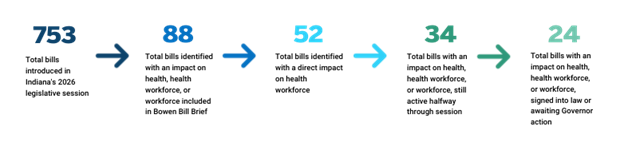
The 2026 Indiana legislative session has come to a close! At the start of this session, the Bowen Center for Health Workforce Research and Policy began tracking 88 bills related to or significantly impacting the health workforce. Of those, 24 made it through the full legislative process and have been signed into public law or are awaiting action by the governor. As we review the health workforce bills that advanced this year, two major themes emerge: updates to licensing, scope, and training requirements and behavioral health workforce development.
Licensing, Scope, and Training Updates
Many of the new laws passed this session will modify how clinicians are licensed, supervised, training, and practicing on the ground.
- Senate Enrolled Act (SEA) 180 has wide-ranging impacts across several health professions. For home health aides, it removes the requirement that training programs include at least 75 hours of training and 16 hours of classroom instruction before supervised practical training begins. This act also creates a new licensure pathway to become a dental hygienist for people who completed their dental schooling abroad and modifies examination requirements for respiratory care practitioners beginning in 2028.
- House Enrolled Act (HEA) 1358 focuses on medical education and requires all Indiana medical schools to ensure students receive instruction on nutrition and complete a rural health rotation. This is a meaningful step toward ensuring physicians are prepared to support the health and wellness of Hoosier communities, including rural ones.
- SEA 90 will affect many licensed healthcare professionals and those in training as it prohibits practitioners from performing pelvic, prostate, or rectal examinations on unconscious patients except in specifically outlined circumstances.
- SEA 56 and SEA 293 both modify examination requirements for licensure. SEA 56 opens a pathway for veterinarians to obtain licensure without completing an examination if certain other criteria are met. On the other hand, SEA 293 focuses on pharmacists and specifically lists the required examination in statute.
Behavioral Health Workforce
Consistent with the Bowen Center’s recent focus on behavioral health workforce, several passed bills reflect attention to this space.
- SEA 222 requires the secretary of Indiana Family and Social Services Administration (FSSA), or a designee, to implement standards and administer certifications for certified community behavioral health clinics, recovery organizations and residences, and certified peers. It also defines certified peers as individuals trained and certified by the Division of Mental Health and Addiction or an approved certification body.
- HEA 1296 similarly requires the secretary of FSSA, or a designee, to certify integrated reentry and correctional support programs, defined as programs providing mental health and substance use services and supports to individuals during incarceration and reentry.
- HEA 1266 is particularly noteworthy as it includes provisions directly related to a recommendation in the Playbook for Enhancing Indiana’s Mental and Behavioral Health Workforce. It requires state higher education institutions to determine the feasibility of creating accelerated graduate degree pathways in mental or behavioral health, an important step toward growing a pipeline of qualified providers.
As the 2026 legislative session wraps up, it is worth taking a moment to recognize the meaningful progress made in strengthening Indiana’s health workforce. Thank you for following along with us this session! Be sure to check out our other data and resources in the library.
by Mykayla Moore | Feb 18, 2026 | Policy
The Bowen Center for Health Workforce Research and Policy’s mission is to “inform health workforce policy that advances health.” This week’s blog looks at the workforce data behind recent legislative committee discussions on home health aide training and infrastructure improvements.
Home Health Aide Training Requirements
Home health aides are healthcare paraprofessionals who provide basic health support tasks, such as measuring vitals and simple dressing changes, to older adults and individuals with disabilities through licensed home health agencies. In 2022, the Bowen Center conducted a comprehensive review of state statute for home health aides and other direct care workers to support the Family and Social Services Administration’s Direct Service Workforce Plan. This review identified job functions, populations served, and training requirements for home health aides. Last week, legislation regarding those training requirements moved forward. Senate Bill (SB) 180 passed through the House Public Health Committee on February 10. This legislation would modify the requirement for home health aide training programs to include at least 75 hours of training and 16 hours of classroom training before providing supervised practical experience. If enacted, training would still be required in select topics, such as infection control and maintaining a clean, safe, and healthy environment.
For more data on Indiana’s home health aide workforce and other direct care workers, check out the interactive dashboard. New data are anticipated this fall.
Veterans Affairs Medical Center Infrastructure
Having enough training opportunities for healthcare students is essential for building Indiana’s health workforce, as most healthcare students are required to complete supervised clinical internships or practical experiences. The Richard L. Roudebush Veterans Affairs Medical Center (Indianapolis VAMC) has supported health professional training for over 50 years and partners with many of the universities and colleges across Indiana.
In 2022, the Bowen Center collaborated with Indianapolis VAMC to evaluate its impact on health workforce training in Indiana. Key findings include:
- Indianapolis VAMC commits approximately $90 million annually to supporting Indiana‘s future health professions
- More than 1,800 professionals across Indiana completed some of their training at Indianapolis VAMC.
Indianapolis VAMC plays a critical role in developing and strengthening Indiana’s health workforce. However, space and infrastructure have limited their ability to expand these efforts. SB 225 includes a provision that seeks to alleviate these infrastructure concerns. By modifying the duties of an existing subsidiary of the state department of health to include “enhance[ment] of health care resources and infrastructure for veterans,” an opportunity opens for the state of Indiana to receive federal funding to enhance the Indianapolis VAMC building. This bill also passed out of the Public Health Committee on February 10. We’ll keep tracking this bill and others as they move through the legislative process.
by Mykayla Moore | Feb 2, 2026 | Policy
The Bowen Center for Health Workforce Research and Policy is committed to informing health workforce policy that advances health. One way we do this is by staying up to date during the legislative session. Let’s discuss how the Bowen Center’s research and resources can support the work of the Indiana General Assembly.
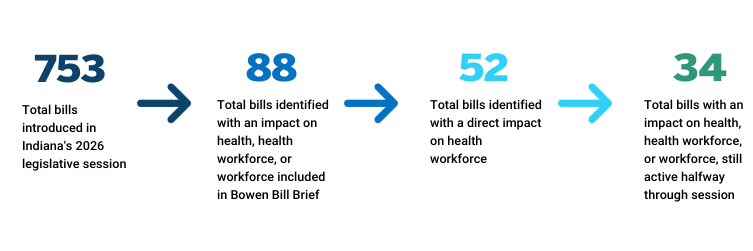
While there were no committee meetings held the week of January 26, deadlines for second and third readings occurred, meaning the number of bills the Bowen Center is tracking has decreased. From the original 88 bills, 34 are still moving through the legislative process, with several impacting workforces the Bowen Center actively monitors and reports on.
Nursing represents one of the largest health professions in Indiana, with over 73,500 registered nurses reporting that they actively provide clinical services to Hoosiers. The most recent series of workforce snapshots dives deep into this workforce. There are snapshots calling out data for all RNs, RNs only, advanced practice registered nurses, and the APRN subspecialties, including clinical nurse specialists, certified nurse midwives, and more. Many (78.7%) of these RNs completed their education in Indiana, making Indiana’s nursing program standards particularly important for nursing workforce development. House Bill (HB) 1278 would modify education standards for specified nursing programs, allowing programs in operation for at least five years to increase their enrollment at any rate they deem appropriate. Current law limits increases to not more than 100%.
The Bowen Center also closely monitors Indiana’s pharmacy workforce. We publish reports on this workforce biannually, with the next report with fresh data coming early spring. Looking at the most recent report, published in 2024, 6,029 pharmacists reported actively practicing across the state, with 72.3% (n=4,359) of those individuals completing their education in Indiana. About 25.6% of all actively practicing pharmacists completed their education in the United States but not in Indiana.
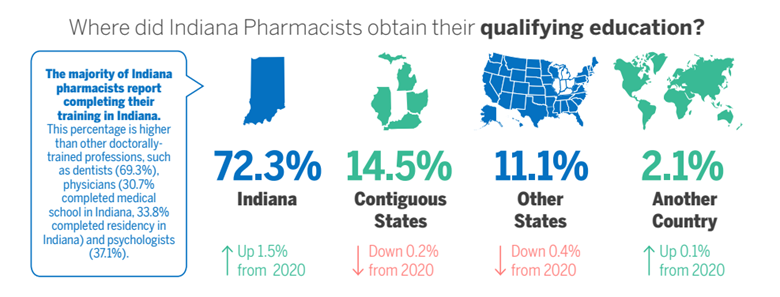
Senate Bill (SB) 293 seeks to modify the requirements for licensure for those individuals who completed an educational program outside of Indiana. If passed into state law, this would require these individuals to complete an “initial course of education” covering federal and Indiana statutes and rules governing the practice of pharmacy.
When we look at issues that cut across the different occupations in the health workforce, the aging population is a major one. Nurses, pharmacists, physicians, behavioral health professionals, home health aides, and even unlicensed healthcare workers interact with the aging population, which continues to grow. The Bowen Center’s director, Dr. Hannah Maxey, testified to the U.S. Senate Special Committee on Aging in 2023, discussing the role states play in ensuring a qualified workforce ready to support the aging population (starting at 43:22). When we look at the data, we see 68% of nurses, 90% of pharmacists, 78% of physicians, and 88% of certified nurse aides report providing services to patients over the age of 65.
The Indiana General Assembly recognizing the importance of developing strong communities to care for and support aging adults, as there are several bills continuing to move through the process related to this demographic. This includes HB 1029, which would require the Indiana Department of Health to educate healthcare workers on the appropriate diagnosis, treatment, and care for Alzheimer’s disease and dementia. SB 222 also has provisions related to Alzheimer’s disease, dementia, and the healthcare workforce. The bill would rename the Bureau of Aging and In-Home Services and require the new Bureau of Better Aging to develop a dementia strategic plan for enhancing the dementia-based health workforce, including describing dementia-specific training requirements and how to increase the number of individuals interested in dementia care and geriatrics careers in the future.
As always, the Bowen Center will be back next week to infuse our research and resources into health workforce policy conversations.
by Mykayla Moore | Jan 28, 2026 | Policy
Often, one bill may include several different provisions that impact various health professions. House Bill (HB) 1358, which was heard and passed with amendments by the House Public Health Committee on January 20, is one of those bills. Let’s take a closer look.
Rural Graduate Medical Education
HB 1358 seeks to address medical education through provisions that would require students from Indiana medical schools to complete a rural health rotation before completing their degree program.
This bill intersects with the work of the Indiana Health Workforce Council (HWC). The Bowen Center has provided technical assistance to the HWC since its inception in 2024. A recent report summarizes the yearlong work of the HWC’s obstetrics and gynecology (OB/GYN) focus group to assess and develop recommendations to strengthen Indiana’s OB/GYN workforce. Through research, stakeholder engagement, and Bowen Center-supported analyses, the subcommittee identified several actionable strategies to improve maternal health workforce capacity.
One of these recommendations is to expand the rural training received by medical students and medical residents at these rotations, meaningfully increasing the likelihood that physicians will ultimately practice in rural areas. This makes them a potential tool addressing maternity care challenges in rural Indiana.
Trauma Registry
Apart from integrating rural rotations into medical education, HB 1358 would also establish a trauma registry in Indiana statute. Trauma registries collect information about traumatic injuries across a state to evaluate the delivery of care and support prevention. The Indiana Department of Health (IDOH) has created administrative rules for Indiana’s trauma registry, but there is no binding state statute. However, that may change. If implemented as state law, HB 1358 would formalize Indiana’s trauma registry in statute and void the administrative rules currently governing the registry.
One of the Bowen Center’s active projects is supporting IDOH’s Traumatic Brain Injury (TBI) work. IDOH is responsible for the development and implementation of a statewide comprehensive trauma care system. As part of this responsibility, IDOH regularly assesses the state’s TBI system of care and develops a TBI State Plan. The Bowen Center is currently conducting an evaluation of the health workforce providing TBI services to support future state initiatives.
This work included a review of state statutes from Indiana’s contiguous states and several others to identify areas of opportunity to enhance the TBI system of care. One notable finding is that several states have trauma registries, including Indiana. The Bowen Center is set to release findings from this work this spring.
From rural rotations to trauma registries, HB 1358 demonstrates how legislation can address multiple dimensions of healthcare workforce challenges simultaneously. The Bowen Center will continue to monitor this bill’s progress and provide data-driven insights on Indiana’s health workforce landscape. Check out the full HWC report to learn more about opportunities to support the maternal care workforce and subscribe to our newsletter to stay informed about the trauma care findings this spring.
by Mykayla Moore | Jan 20, 2026 | Policy
The 2026 Bowen Bill Brief (B3) is now live! This year marks the 8th year the Bowen Center has monitored health workforce legislation introduced in the Indiana General Assembly.
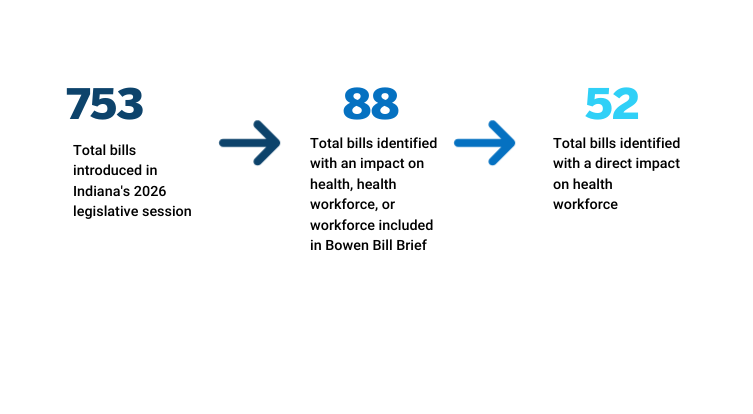
This year, 753 bills were introduced, and the Bowen Center will be tracking 88 that relate to or significantly impact the health workforce. Of those, 52 have direct relevance to the health workforce and are indicated as such in the B3.
The bills the Bowen Center is tracking cover diverse topics, with Other, Cost, and Regulatory being the most common categories. Bills in these categories cover issues like battery against health care providers (House Bill (HB) 1040), health care debt and insurance reimbursement (HB 1393, Senate Bill (SB) 178), and modifications to regulatory boards (HB 1230). This year, we’ll focus on areas where the Bowen Center can elevate research and data into policy discussions.
The Bowen Center recently released a brief outlining Indiana’s capacity for clinical training within the behavioral health and human services (BHHS) workforce. In it, we described findings that BHHS professionals (social workers, counselors, and therapists) report challenges serving as clinical or field preceptors because of the impact on their pay, productivity, and workflow. This information builds on the findings of the Playbook Project, which involved stakeholder engagement with behavioral health professionals, employers, and educators across Indiana.
During that project, stakeholders raised concerns about the length of time it takes to enter the behavioral health workforce. Following the typical path, students may spend 4 years earning a bachelor’s degree, another 2 years earning a master’s degree, and another 2 years of practicing under supervision before reaching independent practice.
Legislators are cognizant of these challenges, and there are several behavioral health bills this session. SB 68 seeks to directly address these delays and would require higher education institutions to create at least one accelerated graduate degree program to reduce the time needed to enter the workforce. SB 222 focuses on the peer support workforce and would define certified peers as individuals trained and certified by the Department of Mental Health and Addiction or an approved national body. HB 1134 seeks to expand the definition of treatment for mental illness or substance use to include services provided by behavioral health professionals holding associate licenses or the licensed social work license.
The General Assembly has been hard at work! Both the Senate Health and Provider Services Committee and the House Public Health Committee met during the week of January 12. Several bills with direct relevance to the health workforce were discussed during their meetings, including SB 222 described above. As examples, SB 173 and HB 1254 were passed with amendments out of their respective committees. These bills seek to open a pathway to licensure as dental hygienists for individuals with dental doctorates from foreign countries, in addition to other policies affecting the health workforce.
What does the data tell us about dental hygienists? More than 3,800 dental hygienists are providing services to Hoosiers in all but 3 of Indiana’s 92 counties. Looking at demand, estimated job growth in Indiana outpaces national job growth. If passed, this legislation may increase the number of dental hygienists practicing in the state, supporting the oral health needs of Hoosiers. For more information, check out the Bowen Center’s new brief: Indiana’s Dental Hygiene Workforce 2024 Supply and Demand.
Looking at emergency medical services (EMS), the Bowen Center has partnered with the Indiana Department of Homeland Security since 2023 to monitor and report on the EMS workforce. This partnership has resulted in a statewide assessment of the workforce, student reports summarizing the perceptions of individuals pursuing these careers, and informational flyers to support recruitment and retention. State legislators are considering various bills related to this workforce, including HB 1251, which would define EMS as essential in Indiana, requiring county commissioners to identify areas with insufficient capacity and provide services to those areas. Check out the EMS webpage for resources from our work on these vital professionals.
For a more detailed description of all the bills we’re tracking, interactive graphics, and more information, check out the Bowen Bill Brief webpage. Make sure you’re signed up for our newsletter, and follow us on LinkedIn to receive our communications during this legislative session.